
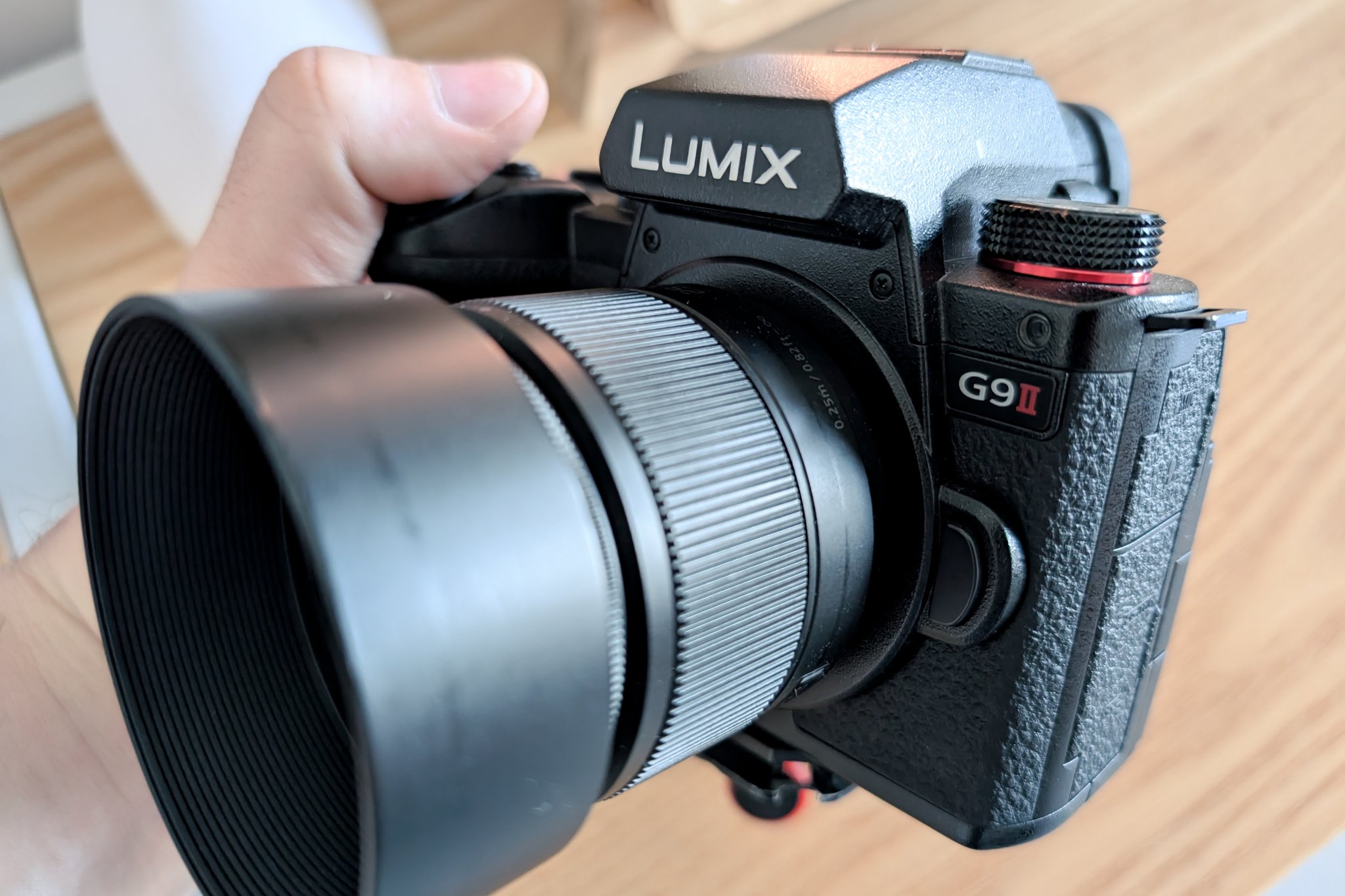
I don’t usually do gear reviews. I’m mostly a nerd in general, but I don’t obsess over things I consider tools to achieve a certain goal, like my photography gear.
I’ve had my Panasonic Lumix G9II for almost a year and a half now, and I think I can share some thoughts on this camera. I bought it almost immediately after it came out to replace my G9, which was great but had a few details I wanted to improve – ones that held my photography experience back.
Also, keep in mind that I use my camera exclusively for photos and never for video – I even disabled the red dot button to avoid pressing it inadvertently.
Ergonomics
I simply love how this camera feels in my hands.
Of course, it’s personal, but the size and weight are just right for me, and the grips are well-designed for one-handed use. I can reach all the relevant controls with my thumb and index finger, and my muscle memory does the rest.
I secretly envy those who use smaller, lighter cameras – the GX9 comes to mind – but I find them uncomfortable in my largish hands.
Many said the G9’s shutter button felt very soft – and they were right. The G9II’s is a bit stiffer, but it still lacks a clear “click” or physical feedback when the shutter is actuated. It takes some time to get used to, but I believe it’s the best solution for stabilization and preventing camera shake.
Autofocus
First off, the G9II’s autofocus is great in the vast majority of circumstances. The upgrade from contrast to hybrid (phase-detect + contrast) AF is noticeable in terms of speed.
So, all good, right?
Well, I have one specific use case where the AF underperforms – at least for me: low-light scenes with low contrast. In those cases, even with fast prime lenses, the autofocus struggles and sometimes can’t lock onto anything. I have to focus on something else and recompose. It’s not a problem in most situations, but for night street photography, it has caused some missed shots.
That said, I use a small central area as the focus target, and increasing its size usually helps. I also acknowledge that most cameras struggle in such conditions.
Stabilization
I was impressed with the G9’s stabilization, and the G9II is even better.
Just yesterday, I captured a 3.2-second exposure on my 25mm f/1.7 prime handheld, and it came out sharp – with the mechanical shutter.
Of course, it depends on the focal length, but overall, this camera is excellent, and I have zero complaints.
Software And Reliability
If the camera has been off for a long time, it takes a few seconds to turn back on – but that’s fine, because after that, turning it on and off is instant. I can spot a shot, reach for my camera, turn it on with one finger, and by the time the viewfinder is in front of my eye, the camera is ready to shoot.
I had my G9 lock up on me a handful of times, but not often. It has happened a bit more with my G9II. When it does, the camera becomes unresponsive and won’t turn off, even when I move the switch to the off position and leave it there for several seconds. The only fix is to remove the battery.
Some say it’s due to defective SD cards, so I changed them, and the jury is still out. I understand that modern camera software is extremely complex and bugs happen, but it has occurred enough times that it feels like a bit too many – especially since I’ve lost a couple of shots because of it.
Build Quality
My G9 was a tank. It never fell – but I fell onto it. On gravel. We both got some battle scars, but it kept working perfectly. Some rubber pads started coming off after about two years of use and 15,000 shots, but that seemed like a common issue. I fixed them with superglue and kept shooting.
My G9II is still a tank. I haven’t (yet) fallen onto it, and after almost 1.5 years of use and 6,000 shots, the rubber grips are still intact.
The only thing I don’t like is the lens release button. It’s plastic and feels a bit clunky. Mind you, the lens retention pin that retracts when you press the button is stainless steel – like the entire lens mount – and works perfectly fine. I’d just prefer it to feel a bit more substantial.
Battery Life
I had two batteries for my G9, but only one for my G9II. I get about 300 shots per charge, which is more than enough for a full day.
USB-C charging is reasonably fast – certainly quick enough to top up from a power bank over lunch, for example – but I’ve never needed to.
I am happy.
Screen And Viewfinder
I reckon the viewfinder isn’t the best in the world, but it works fine in most conditions, and I use it for 99% of my shots. It’s clear enough to read all the settings and determine whether the subject is in focus. That’s enough for me.
I use the articulating LCD screen to compose only when shooting from an awkward angle or using a tripod, and it’s never a particularly nice experience. I wish it were a bit larger, but the resolution is perfectly adequate for the job.
One thing I really, really miss is the ability to simply flip it up when the camera is horizontal. Instead, I have to flip it to the side first and then up. It’s an awkward orientation that makes composition harder, especially in street photography – which is why I never do it.
Customization
On the G9II, you can customize pretty much any button and dial, plus you get three custom modes on the top-right dial (C3 has sub-modes that you can select via the menus).
I’ve set mine like this:
- Video record button: Disabled
- C1: Settings for daytime street photography
- C2: Settings for night street photography
I’ve also configured the two front buttons between the lens mount and the grip to do something (change shutter type, maybe?), but I never use them.
My G9II is set to save both JPGs and RAWs to both SD cards as protection against card failures.
Other relevant customizations – common to all good cameras – include the auto-ISO range and minimum shutter speed.
Weather Proofing
I’ve never been to Antarctica or the Sahara Desert. That said, my camera has never had any weather-related issues.
Last summer, even when it was almost hot to the touch from intense, direct sunlight, it worked perfectly.
In Shetland, it got slightly wet a couple of times – no problems at all.
More recently, I had my G9II hanging from my neck strap while walking through the woods in the rain and then snow, without any protection. The camera was literally dripping with partly frozen water droplets, but it kept shooting happily. I did notice a slight drop in battery life, but that’s normal in cold weather.
Of course, I don’t change lenses when the camera is that wet.
I’m not sure if this is due to weather sealing or other factors, but I’ve almost never had dust particles on the sensor. On the rare occasions I did, I removed them with a small air blower. I’ve had a sensor cleaning kit for years now, and I’ve never needed to use it.
Burst Mode
I know many are particularly interested in burst mode capabilities – maybe for sports and wildlife photography.
Personally, since I’m not into either of those, I don’t need super-fast burst shooting and I use it sparingly. I absolutely hate going through dozens of almost identical shots to find the best ones. I use it in urban settings when there’s a high chance of missing the shot by a fraction of a second. I consider it a very posh feature to have on my camera.
Image Quality
You can’t compare a Micro 4/3 camera with a full-frame one.
That said, for what it is, I’m really impressed by the improvement in image quality over the older G9. Noise is substantially lower, especially up to ISO 3200, and shadows are much more recoverable in RAW files than before. I stopped bracketing shots and now underexpose them instead. In rare cases, if I want a particularly clean image, I run it through Lightroom’s AI noise removal function, and that’s it.
Also, I think 25 MP is the right balance between being able to crop in a little and having manageable RAW files – especially when editing them in Lightroom for Android.
Conclusions
There are many things I didn’t mention here, like Hi-Res Mode and Live View Composite mode, but as I said, this wasn’t really a review of the Lumix G9II.
Overall, it’s a great camera. I certainly don’t miss my G9, and in all honesty, I can’t think of anything this camera lacks that would improve my photography experience.
I’ve come to love this camera because it’s an extension of my photographic eye – a tool to create images without getting in the way too much. I probably shoot around 75% street and 25% landscape, and I believe this camera allows me to do both successfully.
So, for me, the G9II was a worthy upgrade over the G9.