
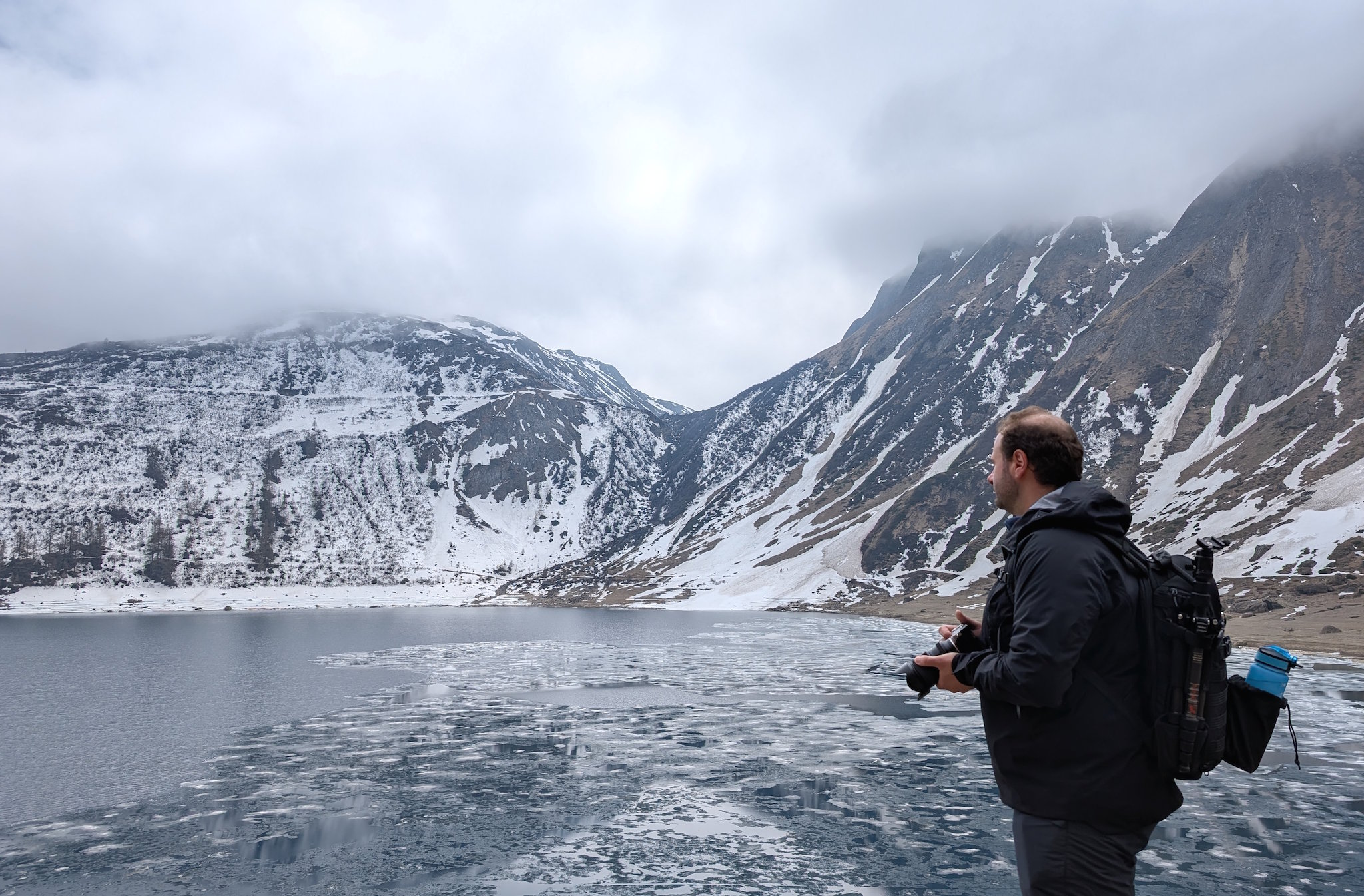
A few weeks ago, after approximately five minutes of “careful consideration,” I rage-purchased a used Sony α7CII with a 40mm f/2.5 G lens.
I’d been feeling vaguely unsatisfied with my Lumix setup for a while – maybe bored, maybe restless, maybe just susceptible to late-night gear browsing. The usual.
Here’s my situation: 99% of my shots are travel and street photography, which means I’m lugging a camera around all day on a cross-body strap. For years, that camera was a Lumix G9II (and a G9 before that), paired with a 25mm lens – a classic 50mm full-frame equivalent. The whole setup weighed around 700g, which sounds perfectly reasonable until it’s been hanging off your shoulder for six hours in July. And for reasons I’ve never fully understood, 25mm lenses on Micro 4/3 tend to run large – especially my Panasonic Leica f/1.4, which is frankly a bit of a unit.
My goal was simple: carry one camera, with one lens, for 90% of my shots, with enough resolution to crop in a bit when needed. One “flagship” digital camera. That’s it.
New Gear
In the end, I replaced my old Lumix kit with:
- Sony α7CII
- Sony 40mm f/2.5 G
- Sony 28-60mm f/4-5.6 “pancake” zoom
- Tamron 28-300mm f/4-7.1 Di III VC VXD.
First Impressions
Build quality feels on par with top-of-the-line Lumix gear. The menus – famously Sony’s weakest point for years, I’m told – are actually easy to navigate now. Ergonomics are solid despite the smaller body. And yes, the weight difference with the 40mm is very much noticeable.
Six Years of Lumix Muscle Memory, Undone
Switching from 4:3 to 3:2 felt like a bigger deal than it actually was – I adjusted within a few days. I do still often crop to 3:4 for verticals, though. Horizontal framing feels more natural in 3:2; vertical, less so.
Shallower depth of field on full-frame took a bit of recalibrating: I now just double my aperture values mentally and move on. The upside is that subject separation looks great.
The Tamron 28-300mm is, let’s be honest, enormous. But it handles well, even after a full day on the trail.
Direct Comparison: What Actually Matters
What I miss about the Lumix G9II:
- IBIS. Genuinely, painfully miss it. The G9II let me shoot 2-second handheld exposures; the α7CII tops out at about half a second. That’s a meaningful step back.
- AF-lock toggle. Apparently there’s no way to lock autofocus with a single button on the α7CII. I’m still a little baffled by this.
Things that are roughly the same:
- The α7CII has no joystick, but the one on the G9II was unreliable enough that I wasn’t really using it anyway. The touchscreen is my go-to now – equally imperfect, but familiar.
- Raw file color rendition is similar: neutral, slightly muted. I’m fine with that.
- The α7CII tends to overexpose slightly, but a bit of exposure compensation (or a nudge in post) sorts it out.
- Electronic front-curtain vs. fully mechanical shutter: no visible difference in real-world use, even with artificial lighting.
- High-ISO performance is better on the Sony – full-frame advantage – but since the lenses are generally slower, you end up needing that higher ISO anyway. Net result: roughly the same noise levels.
The “less is more” category:
- The viewfinder is clearly inferior, but since I only use it in specific conditions, the size and weight savings feel like a fair trade.
- 33MP vs. 25MP gives plenty of cropping room, though Lightroom is noticeably slower to chew through the files.
- Autofocus with the 40mm f/2.5 G is instant – even in the dark.
- The kit 28-60mm “pancake” zoom that everyone loves to dismiss is actually quite good. Sharp, versatile, and genuinely compact. I use it almost like a variable prime: it lives at 40mm (its shortest physical length) and zooms on or out only when a shot demands it.
Conclusions
Can I say I’m 100% satisfied? No. But I’m more satisfied than I was before, which is… something, I guess.
I made deliberate trade-offs for hiking – use cases that come up a handful of times a year versus street photography, which I do multiple times a week. The math works in favour of the Sony.
The honest truth is I’d been waiting for a new Lumix GX9 for years. It never came. My dream camera remains a GX9 with 90% of the G9 II’s feature set – especially the IBIS – plus a fast, sharp 20mm prime with great autofocus. I haven’t given up hope, and given my track record, I’d probably switch again if that camera ever materialised. Heard that, Panasonic? Watch this space.